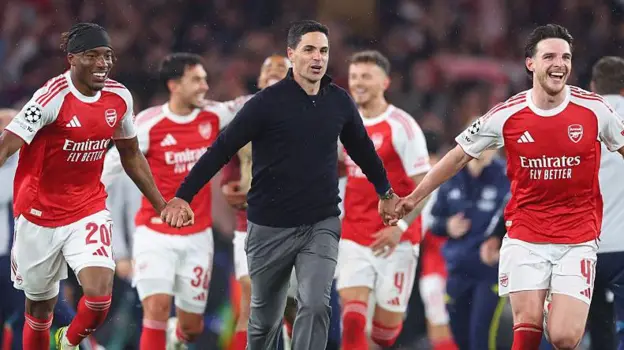
For a club starved of European glory for so long, the scenes of celebration surrounding Arsenal F.C. in recent weeks were perhaps inevitable. Players danced, fans flooded the streets, social media exploded with emotion, and pundits debated whether the North London side had finally rediscovered its continental identity.
But amid the euphoria came a familiar question from rivals and critics alike: was Arsenal’s ecstasy truly justified, or was it all just a bit too much?
The debate has quickly become one of football’s hottest talking points.
For Arsenal supporters, the answer is simple. After years of frustration, near-misses, and painful exits from Europe’s elite competition, seeing their club back among the continent’s heavyweights felt like a release of years of pent-up emotion. Under manager Mikel Arteta, Arsenal have transformed from an inconsistent rebuilding project into a genuine force capable of challenging Europe’s biggest clubs.
That emotional explosion wasn’t merely about one victory or one performance. It represented validation. Arsenal’s young squad, led by stars like Bukayo Saka, Martin Ødegaard and Declan Rice, has matured under immense pressure, turning skepticism into belief.
And supporters argue that football is, ultimately, about emotion. If fans cannot celebrate major moments passionately, then what is the point?
Still, critics have questioned whether the reaction crossed the line into premature triumphalism.
Some rival supporters pointed to the scale of the celebrations as though Arsenal had already won a trophy. Television pundits and online commentators accused the club of behaving like champions before actually lifting silverware. In the hyper-competitive world of modern football, those reactions were predictable.
This is not the first time Arsenal have faced accusations of “over-celebrating.” Arteta’s highly emotional touchline behavior and the visible unity within the squad have often divided opinion. To some, it reflects a healthy culture filled with belief and togetherness. To others, it appears theatrical.
But football history suggests emotional momentum matters.
Many of Europe’s greatest sides have built success on collective passion and connection with supporters. Teams that appear emotionally flat rarely inspire lasting greatness. Arsenal’s visible joy may simply be a sign of a club reconnecting with its identity after years of uncertainty.
There is also a double standard at play. Celebrations from certain elite clubs are often framed as “winning mentality,” while Arsenal’s are sometimes dismissed as excessive enthusiasm. That contrast has not gone unnoticed among fans.
Former players have also defended the reaction. Several pundits noted that Arsenal’s resurgence has been years in the making, involving difficult squad rebuilds, heavy criticism, and enormous pressure on a young team. In that context, moments of emotional release become understandable.
Of course, the real judgment will come with trophies.
In elite football, celebrations are remembered fondly when they are followed by silverware. Without titles, critics inevitably revisit those moments with ridicule. Arsenal’s challenge now is ensuring their emotional highs are matched by sustained success on the pitch.
Yet perhaps that uncertainty is precisely what made the celebrations feel authentic.
Football is increasingly corporate, calculated, and media-managed. Raw emotion, whether joy, relief, or even chaos, reminds supporters why they fell in love with the sport in the first place. Arsenal’s scenes of ecstasy may have looked dramatic, but they also felt real.
And in a game built on passion, maybe that alone justifies them.
Leave a Reply