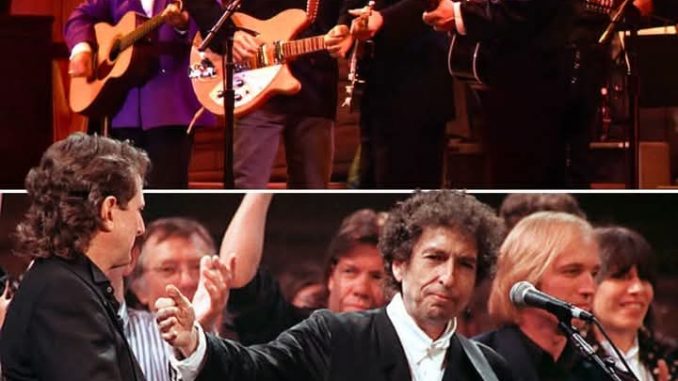
On October 16, 1992, inside New York City’s Madison Square Garden, Bob Dylan stood at the center of an event that felt less like a tribute show and more like a living chapter of American music history. Officially titled The 30th Anniversary Concert Celebration, the night marked three decades since Dylan’s arrival in New York and his emergence as a songwriting force that would reshape folk, rock, and popular culture itself. Unofficially, it was something bigger: a gathering of generations, genres, and giants, all orbiting around the songs of one man.
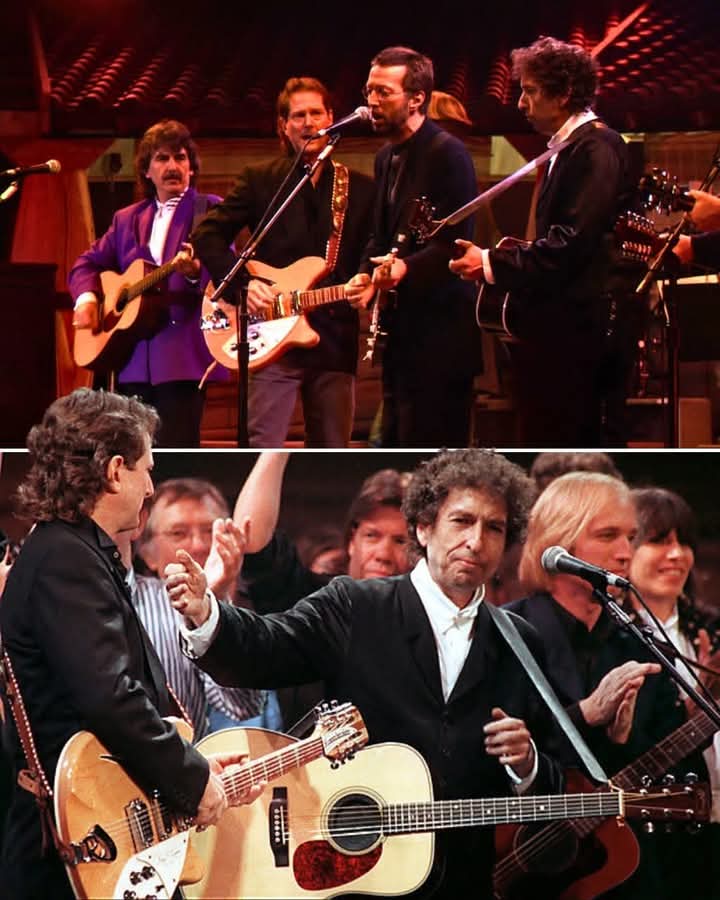
From the moment the lights went down, it was clear this wasn’t designed as a polite retrospective. The lineup alone told the story. Eric Clapton, George Harrison, Neil Young, Tom Petty, Johnny Cash, Lou Reed, Chrissie Hynde, Stevie Wonder, Ron Wood, and Sinéad O’Connor were just a few of the names who took the stage. Each artist didn’t merely cover Dylan’s work—they filtered it through their own identity, proving how elastic and indestructible those songs really were.
The performances were wildly varied in tone and style, and that unpredictability felt appropriate. Dylan’s catalog has always thrived on reinvention, and the concert honored that spirit. Neil Young’s raw, feedback-laced reading of “All Along the Watchtower” collided beautifully with Johnny Cash’s stark, reverent delivery of “It Ain’t Me, Babe.” Lou Reed turned “Foot of Pride” into something abrasive and confrontational, while Stevie Wonder transformed “Blowin’ in the Wind” into a soulful meditation that seemed to float above the arena.
Of course, no account of the night is complete without addressing the most controversial moment. Sinéad O’Connor, scheduled to perform “I Believe in You,” walked onstage to a mix of boos and hostility stemming from her recent appearance on Saturday Night Live, where she tore up a photo of Pope John Paul II. Visibly shaken but defiant, she abandoned the song and instead delivered an a cappella version of Bob Marley’s “War.” It was uncomfortable, courageous, and utterly inescapable, another reminder that this concert wasn’t about safe nostalgia. It was about confrontation, conviction, and consequence, all values deeply embedded in Dylan’s legacy.
When Dylan himself finally took the stage near the end of the night, it didn’t feel like the “main event” in a traditional sense. Instead, it felt like the source returning after watching the river flow outward in every direction. Backed by a band that included G.E. Smith, Dylan tore through a short but potent set featuring “Like a Rolling Stone,” “Mr. Tambourine Man,” and “Rainy Day Women #12 & 35.” His voice was rough, his delivery playful and unpredictable, but the authority was unquestionable. These songs didn’t belong to the past, they were still alive, still dangerous, still capable of filling an arena with meaning.
What made the 30th Anniversary Concert truly historic wasn’t perfection. There were rough edges, uneven performances, and moments of chaos. But that messiness was the point. Dylan’s career has never been about polish; it’s been about movement, challenge, and refusal to stand still. The concert mirrored that ethos exactly.
Three decades after he first arrived in New York with little more than ambition and a head full of songs, Bob Dylan didn’t just receive a tribute. He presided over a summit of modern music, where artists from folk, rock, punk, soul, and country all testified, sometimes awkwardly, sometimes brilliantly, to his impact. The night captured something that can’t be recreated: the feeling that the past, present, and future of popular music were sharing the same stage.
The 1992 Bob Dylan 30th Anniversary Concert wasn’t just a concert. It was history happening right in front of us, and somehow, it still is.
Leave a Reply