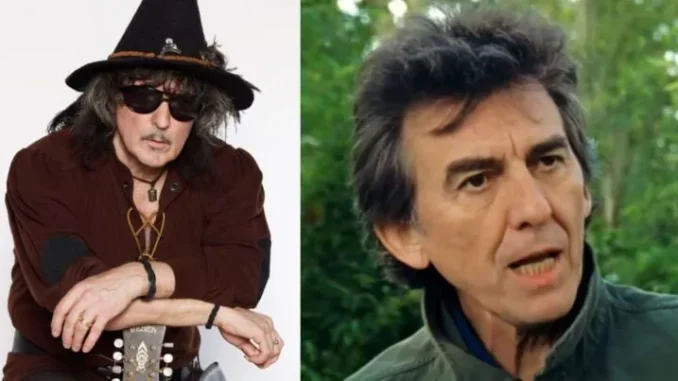
Few guitarists loom larger in rock history than Ritchie Blackmore and George Harrison, yet on the surface, they couldn’t seem more different. Blackmore is synonymous with volume, speed, and fire, his playing with Deep Purple and Rainbow helped define hard rock and early metal. Harrison, by contrast, built his legacy on melody, taste, and spiritual depth. And yet, when Blackmore has spoken about Harrison, his words have carried a tone not of rivalry, but of deep respect.
“He Served The Song”
Ritchie Blackmore has often been blunt about guitar players he doesn’t admire, which makes his praise of George Harrison especially meaningful. According to Blackmore, Harrison’s greatest strength was his discipline.
Harrison, he believed, never played to impress guitarists, he played to serve the song.
That philosophy stood in sharp contrast to the rising culture of guitar heroics in the late 1960s and 1970s, a movement Blackmore himself helped lead. Yet he has openly acknowledged that Harrison’s restraint took far more confidence than endless soloing.
“He didn’t overplay,” Blackmore has noted in past reflections. “He knew exactly what a song needed, and stopped there.”
Melody Over Muscle
Blackmore has frequently emphasized that great guitar playing isn’t about speed, but memorability. In Harrison, he saw a guitarist who understood that truth instinctively. Solos like those in “Something,” “While My Guitar Gently Weeps,” and “Nowhere Man” weren’t flashy, but they were unforgettable.
To Blackmore, Harrison’s lines worked because they were composed, almost vocal in their phrasing. Every note had a purpose. Nothing was wasted.
For a musician often associated with neoclassical scales and aggressive riffing, Blackmore’s admiration for Harrison reveals a side of his own musical values that fans don’t always expect.
Spiritual Depth And Musical Identity
Blackmore has also spoken respectfully about Harrison’s spiritual journey, acknowledging that it shaped his music in a way that set him apart from his contemporaries. Harrison wasn’t chasing trends or trying to dominate the spotlight, he was searching for meaning.
That authenticity resonated with Blackmore, who has long followed his own unconventional path, from medieval-inspired folk music to Renaissance-influenced compositions with Blackmore’s Night.
In Harrison, Blackmore saw an artist who refused to be boxed in, even at the height of global fame.
Quiet Confidence In A Loud World
One of the aspects Blackmore admired most was Harrison’s quiet authority. In a band as massive as The Beatles, Harrison could have easily been overshadowed by Lennon and McCartney. Instead, he carved out his own identity, patiently, persistently, and without ego.
Blackmore has suggested that this kind of confidence, confidence without aggression, is rare in rock music.
“Harrison didn’t need to prove anything,” Blackmore has implied. “That’s why his playing still stands up.”
A Guitarist’s Guitarist, Without The Flash
Ritchie Blackmore’s opinion on George Harrison ultimately comes down to respect for musical intelligence. While their styles differed dramatically, Blackmore recognized in Harrison a guitarist who understood the true power of the instrument: not how much you can play, but how much you choose not to.
In an era obsessed with virtuosity, George Harrison showed that emotion, melody, and silence could be just as powerful as speed and volume.
And for a guitarist as uncompromising as Ritchie Blackmore, that kind of restraint deserves nothing less than admiration.
Leave a Reply