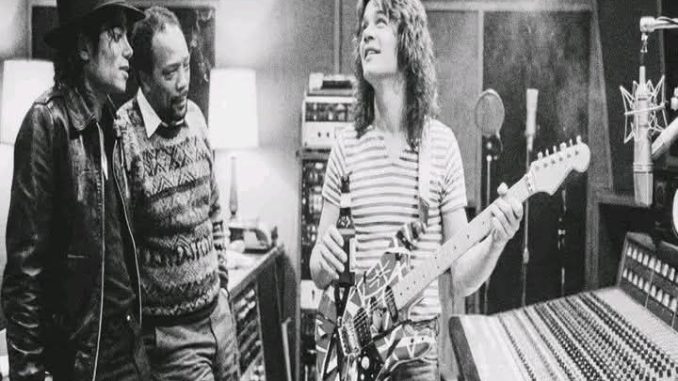
On January 18, 1983, Eddie Van Halen walked into Westlake Recording Studios in Los Angeles with nothing more than his guitar and a beer. He wasn’t dressed for history, and he certainly didn’t expect to make it. Twenty minutes later, he had recorded a guitar solo that would help reshape pop music forever.
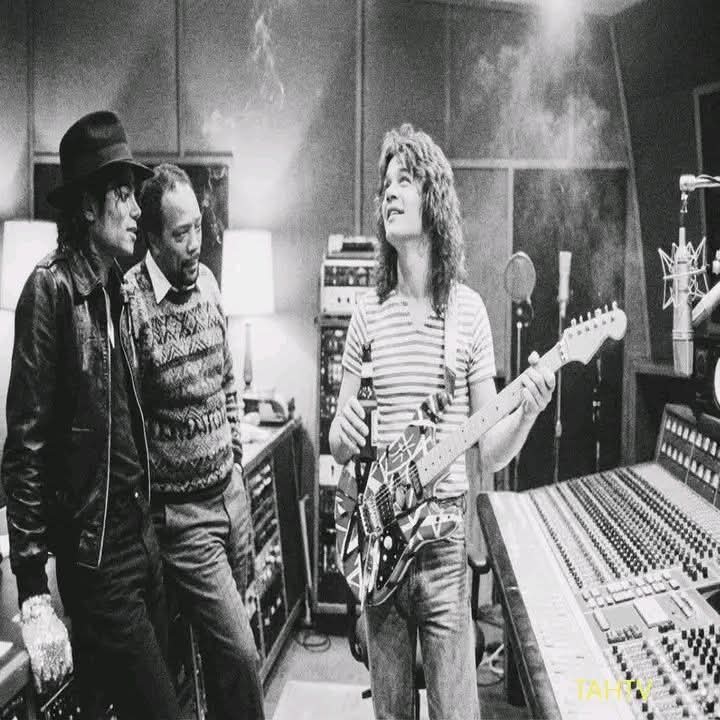
What happened after that session, however, may be even more revealing than the notes he played.
At the time, Eddie Van Halen was untouchable. Van Halen’s Diver Down had gone platinum, arenas were selling out worldwide, and at just 27 years old he was widely regarded as the greatest guitarist on the planet. His sound was revolutionary, his confidence unshakable, and the rock world was his.
So when the phone rang on a quiet Sunday afternoon at his Los Angeles home, Eddie almost ignored it. He was deep into experimenting with new effects — the kind of tinkering that defined his restless creativity. But something made him answer.
“Hello.”
“Eddie, this is Quincy Jones.”
On the other end of the line was the legendary producer behind Frank Sinatra, Ray Charles, and now Michael Jackson’s upcoming album. Eddie assumed it was a prank.
“Yeah, right,” he shot back. “And I’m the Pope.”
But Quincy wasn’t joking. He explained that he was producing Michael Jackson’s new record and that one song needed something special, something only Eddie Van Halen could deliver. Michael himself had asked for him.
The disbelief quickly turned into curiosity.
“Michael Jackson wants me to play on his record?” Eddie asked.
The song was “Beat It.”
Three days later, Eddie showed up at Westlake during a break from Van Halen sessions. He hadn’t heard the track in advance, and there was no contract waiting for him. Quincy Jones warned him that union rules could cause problems if the session leaked, but Eddie didn’t care. He plugged in, listened once, and immediately began mapping out ideas in his head.
Then he did something unexpected.
Eddie asked Quincy to roll tape while he experimented.
The solo everyone knows, the explosive dive-bomb, the lightning-fast runs, the melodic scream that cuts through the song, was largely improvised. Eddie later revealed that he warned Quincy the solo might destroy the speaker system.
He was right. One of the studio monitors blew out.
And just like that, Eddie Van Halen changed pop music. “Beat It” became a global phenomenon, smashing genre boundaries and introducing hard rock guitar to an audience that had never heard anything like it before. MTV rotated the video endlessly. Rock and pop suddenly spoke the same language.
Then came the money.
Michael Jackson’s camp reportedly wanted to pay Eddie handsomely, figures that, over the years, have been inflated into “millions” in music lore. Eddie’s response was immediate and simple.
“I didn’t do it for the money.”
Those were the words that stunned everyone.
Eddie refused payment. He had shown up as a fan, as a musician excited by the idea of collaboration. He played because it felt right. He later joked that his “payment” was being able to tell his friends, “I played on a Michael Jackson record.”
Even more remarkably, Eddie didn’t want his name listed at first. He was worried about how Van Halen’s label might react and didn’t want the moment to be about credit or contracts. It was about the music.
That decision says everything about Eddie Van Halen.
In an industry obsessed with status, money, and ownership, Eddie operated on instinct and joy. He followed curiosity instead of calculation. He believed music should be fun, generous, and shared, not negotiated into the ground.
Decades later, the “Beat It” solo remains one of the most recognizable guitar moments ever recorded. It inspired countless musicians, bridged cultural divides, and proved that virtuosity and pop accessibility didn’t have to be enemies.
Eddie Van Halen could have taken the money. Instead, he gave the world something priceless.
Leave a Reply