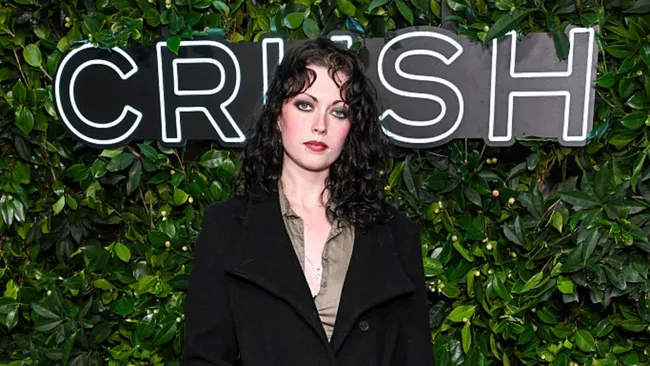
For decades, the Grohl name has been synonymous with authenticity, passion, and an unshakable love for music. From the thunderous drums of Nirvana to the global success of the Foo Fighters, Dave Grohl has built a legacy rooted in honesty and heart.
Now, that legacy appears poised to evolve, not repeat itself, through his daughter, Violet Grohl, an artist industry executives believe represents the next generation of meaningful rock-inspired music.
“She understands the history of music,” one record executive said recently, “but she’s also pushing it forward. She is the future.”
It’s a powerful statement, and one that speaks volumes about the impact Violet is already making before the release of her debut album.
Growing Up Inside The Music
Violet Grohl didn’t discover music, she was born into it.
Raised backstage, in rehearsal rooms, and inside recording studios, she absorbed decades of musical influence long before writing her first song. From classic rock and punk to alternative, pop, and experimental sounds, Violet grew up witnessing how music is created, not manufactured.
Yet despite her famous surname, those closest to her insist she never relied on it.
Instead, she listened. She learned. And she studied the emotional weight behind great songwriting.
That deep respect for music history now forms the backbone of her identity as an artist.
A Voice That Stopped People Cold
Fans first took notice when Violet began appearing alongside her father at select performances, moments that instantly went viral not because of who she was, but because of how she sounded.
Her voice carried uncommon power and vulnerability: raw, expressive, and emotionally fearless.
Whether performing covers or original material, Violet demonstrated a command rarely heard in artists her age. Industry professionals took note almost immediately.
Executives describe her vocals as “commanding but intimate,” capable of shifting from quiet fragility to explosive intensity, a dynamic that recalls classic rock singers while sounding undeniably modern.
Respecting The Past, Creating The Future
What excites labels most isn’t simply Violet’s talent, it’s her musical perspective.
“She understands where music comes from,” one executive explained, “but she’s not trapped by it.”
Her songwriting reflects an appreciation for structure, melody, and storytelling, hallmarks of classic songwriting, while embracing contemporary production, emotional openness, and genre-blurring creativity.
In an era dominated by algorithms and fleeting trends, Violet’s approach feels refreshingly human.
She doesn’t chase nostalgia.
She doesn’t imitate her father.
And she doesn’t attempt to recreate the past.
Instead, she builds upon it.
A Major Label’s Confidence
That philosophy is precisely why record executives expect Violet Grohl to become something rare in modern music: an artist with longevity.
Since signing with Republic Records, insiders have described her as one of the most promising young talents they’ve encountered in years, not just because of her voice, but because of her instinct for meaning.
“She writes like someone who understands emotion,” one source noted. “You can’t teach that.”
Her early releases reveal a musician willing to take risks, balancing alternative rock grit with introspective pop atmospheres, poetic lyrics, and bold sonic choices.
Dave Grohl’s Greatest Influence: Freedom
Perhaps the most striking element of Violet’s rise is what her father has not done.
Dave Grohl has never attempted to shape her sound or guide her direction publicly. Instead, he has given her the same freedom that once fueled his own journey, permission to fail, experiment, and grow naturally.
That freedom has allowed Violet to become an artist on her own terms.
While echoes of her father’s passion remain undeniable, her music belongs entirely to her.
The Future Is Taking Shape
At just 19 years old, Violet Grohl stands at the beginning of what many believe will be a remarkable career.
With strong label backing, early critical praise, and an artistic identity rooted in both tradition and innovation, she represents something increasingly rare in modern music, a bridge between generations.
She honors the past.
She challenges the present.
And she’s building something entirely her own.
As one executive put it:
“She understands the history of music, but she’s also pushing it forward.
She is the future.”
And for the first time in decades, the next chapter of the Grohl musical legacy is being written, not by echoing what came before, but by daring to imagine what comes next.
Leave a Reply