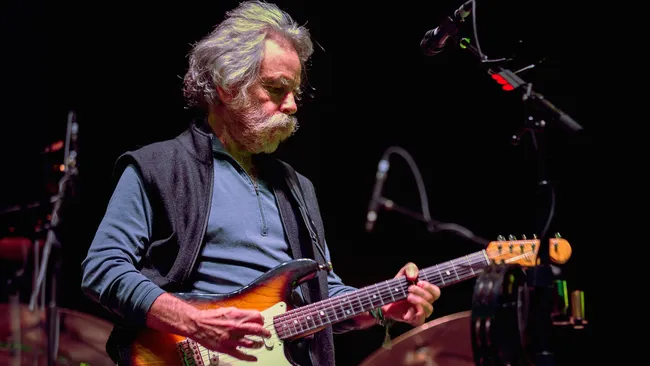
Bob Weir “Sammy Hagar’s best friend” has spent a lifetime doing things his own way. As the ever-curious rhythm architect of the Grateful Dead, Weir built a career on bending rules, musical, cultural, and sometimes personal. But even by his own famously unconventional standards, one story stands out as pure rock ’n’ roll audacity: the day he more or less stole one of jazz legend George Benson’s favorite guitars and refused to give it back.
It’s a tale that has become part of Weir folklore, told with a grin and a shrug, and it perfectly captures the fearless, free-spirited energy that has defined his life on and off the stage.
A Guitar That Spoke To Him
The story dates back to the late 1960s, when Weir was still a young musician absorbing influences from everywhere, folk, blues, jazz, and beyond. During that period, he crossed paths with George Benson, already widely respected for his fluid playing and impeccable tone. Benson owned a guitar that immediately caught Weir’s attention.
From the moment Weir wrapped his hands around it, something clicked.
“It just felt right,” Weir later recalled. The neck, the resonance, the way the notes bloomed, it was one of those rare instruments that seems less like an object and more like an extension of the player. For Weir, that connection was instant and overwhelming.
“I’m Taking It”
Here’s where the story takes its legendary turn. According to Weir, Benson was reluctant to part with the guitar. Understandably so, it was one of his favorites. But Weir, operating on instinct and conviction rather than etiquette, made his position very clear.
“I told them, ‘You can call the police or do whatever you’re going to do to me, but I’m taking it,’” Weir said, laughing years later.
It wasn’t malice or arrogance, it was pure belief. Weir felt that the guitar belonged with him, that it had found its rightful musical home. In the strange, loosely tethered world of late-’60s musicians, that kind of boldness wasn’t entirely unheard of, but few would dare aim it at a player of Benson’s stature.
Somehow, remarkably, the situation didn’t explode into conflict. No police were called. No lawsuits followed. The guitar left with Weir.
A Lifetime Of Unlikely Friendships
The story also fits neatly into the broader picture of Bob Weir as a connector between worlds. He has always floated freely between genres and personalities, forming friendships that seem unlikely on paper but make perfect sense in practice.
One of those friendships is with Sammy Hagar, the hard-rock frontman best known for his time with Van Halen. Despite coming from different musical universes, Weir and Hagar bonded over shared values: freedom, feel, and an unshakable love for the power of a great guitar.
Hagar has often spoken warmly of Weir, praising his authenticity and refusal to compromise. It’s not hard to imagine Hagar hearing the George Benson guitar story and laughing in approval, recognizing in it the same fearless instinct that drives rock musicians to chase tone, truth, and transcendence at any cost.
Not Theft – Fate
To this day, Weir doesn’t frame the incident as theft. In his mind, it was fate asserting itself in an unusually direct way. The guitar became part of his sonic vocabulary, helping shape the shimmering, interlocking textures that defined the Grateful Dead’s sound.
In the end, the story isn’t really about stealing a guitar. It’s about listening to that inner voice, the one that tells you when something is right, even if the world says otherwise.
For Bob Weir, that voice has guided him for more than half a century, from San Francisco ballrooms to stadium stages, from jazz icons to hard-rock friends like Sammy Hagar. And sometimes, it’s led him to say the most Bob Weir sentence imaginable:
You can call the police, but I’m taking it.
Leave a Reply